HMR Fascia Health Protocol
A tensegrity is a net of tight cables that holds separate struts in place, and physics changes how such a structure behaves: warmth, water, and lubrication loosen it, cold and dryness stiffen it. The body is such a system, and its tissue responds to heat, hydration, and lubrication in the same way. This protocol applies that logic. The Perfect Body →
If the perfect body is the reference, this is how a person moves toward it: daily care for the fascia web, from the outside in and the inside out, refined through five years of daily practice. Most of it needs no clinic: warm water, moisturizers, scrapers, vibration, your own hands, time, breath, and attention.
Two directions, one web
Fascia is the continuous connective tissue that wraps and links every muscle, bone, organ, vessel, and nerve. In HMR it is the body's primary system for health, and it can be reached from two directions.
Outside in: water, moisture, pressure, scraping, vibration, heat and cold, and long holds that load the web from the surface. Inside out: breath, internal locks, sound, posture, attention, and nutrition that reach it from within.
Three habits run through all of it. Go slow and stay long: minutes, not seconds. Do it every day. Do as much as you can with your eyes closed, attending to the place being worked, so the mind connects to the body while the tissue changes. Why fascia comes first →
Once fascia has been attended to this way, it becomes highly receptive to change, from outside the body and from within, and the changes hold, rather than fading within minutes as the effects of ordinary stretching do (Ryan et al., 2008).
So far one person has followed this protocol for years, and is working to get others to try it. The experience came in phases. At first the tissue became slightly more receptive, then more and more, until it could be rolled between the fingers and felt in detail. Large adhesions began to break apart under the fingertips, and joints popped and separated, in good ways, as they freed themselves.
Most of this can be done for children, and gently for babies; the most valuable years are through puberty, when the web is growing fastest and is easiest to shape. It is very hard to test in clinics, so it matters that parents learn the protocol on themselves and then teach their children to care for themselves. That brings healthcare to the level of the family rather than the doctor, a shift we think matters for all of humanity. Moisturizing a baby is almost certainly good for it. Do you have kids? →
If nobody has tested this, how do we know it works?
One person has. For about five years, one person has followed this protocol every day and seen results that we have not found documented anywhere, except in Eastern traditions. That is one reason we are so interested in those traditions.
These results have not yet been repeated in anyone else. Doing that safely is one of our main aims.
In our experience, after a sustained period of both mental and physical attention, the fascia becomes far more responsive to the work done on it. We call this state hyper-receptivity.
This is what we report. It has not been replicated in anyone else, and making it happen safely is one of our main missions. Video tutorials on what to do and what not to do are planned.
Water, then moisture, in layers
Shower and soak. Longer, warmer showers and baths hydrate and soften the tissue before the rest of the work. Prepare the bath with moisturizing bath oils and salts, so the skin and the tissue beneath take on moisture during the soak itself.
Research: in tendon, "the lower loads applied at elevated temperatures for prolonged periods were found to produce significantly greater residual elongation" (Warren et al., Arch Phys Med Rehabil, 1976, animal tissue). Showers as fascia care is HMR's view.
Then moisturize in layers, head to toe, scalp included. Start with what absorbs fastest, then seal it with something heavier, then heavier again. Each layer holds the one beneath it in place.
Research: topical 0.1% hyaluronic acid creams "led to significant improvement in skin hydration and elasticity" (Pavicic et al., J Drugs Dermatol, 2011). That study measured skin; that it reaches fascia is HMR's view.
What is established about water: the skin's outer layer takes up and holds water from outside, and its barrier of fats is what keeps that water in (Verdier-Sévrain and Bonté, J Cosmet Dermatol, 2007). Fascia's own water content changes when it is stretched and then rested (Schleip et al., 2012, below). We found no study that measures water passing through the skin into fascia, or that shows drinking water alone changes how hydrated fascia is. HMR's view, that soaking and layered moisturizing hydrate the web from outside in a way drinking cannot, is a hypothesis nobody has tested yet.
The order is the point: thin to thick. The products named are examples, not endorsements.
Pressure, scraping, and vibration
The layers of fascia glide on a film rich in hyaluronan, a long molecule that makes water thick and slippery. That fluid is not like water or oil. It gets thinner the faster it is sheared and the warmer it is, and it gets thicker and stickier when a part of the body is kept still (Cowman, Schmidt, Raghavan, and Stecco, F1000Research, 2015). So anything that slides one layer over another, warms it, or shakes it should make the layers glide more easily, and stillness should do the opposite.
- Scraping drags the skin across the layers beneath: shear. In one small trial, a single session of gua sha scraping produced "a fourfold increase in microcirculation" at the treated skin for the first minutes afterward (Nielsen et al., Explore, 2007, 11 healthy people).
- Vibration shears the same film thousands of times a minute. Five minutes of a massage gun on the calf increased ankle range of motion by 5.4 degrees, about 18%, with no loss of strength (Konrad et al., J Sports Sci Med, 2020, 16 men).
- Sustained pressure and long holds squeeze water out of the tissue slowly; when the load comes off, the tissue takes water back in, in animal tissue to more than it started with (Schleip et al., 2012, cited under long holds below).
These studies are small and measure effects that last minutes to hours. That the changes build up and last, on a body being cared for every day, is HMR's claim.
Tissue scraping
Scrapers of all shapes and sizes, smooth-edged, drawn slowly along the skin to load and mobilize the layers beneath. Different curves reach different contours: the neck, the shins, the soles, the ribs.
Research: instrument-assisted soft tissue mobilization "produced significant (P<.05) short term gains up to 24 hours", though evidence for treating disease is weak (Cheatham et al., J Can Chiropr Assoc, 2016). HMR holds that on receptive fascia, gains last.
Active self-massage with the hands, daily
Using your own hands to find, press, knead, and stretch your own tissue, every day.
Research: self-myofascial release with a foam roller "had a large positive effect on ROM" (range of motion) compared with no exercise (Wilke et al., Sports Med, 2020). Hands are HMR's preferred tool.
Vibration, every kind
Massage guns, vibrating plates and mats, vibrating massage balls, and spiky balls that vibrate and heat at the same time. Vibration reaches the web in a way slow pressure does not.
Research: fascia is densely supplied with nerve endings that respond to pressure and vibration (Schleip, 2003). Lasting effects on fascia are HMR's view.
Massage mats and beds
Lie on a massage mat or bed for long sessions, letting the body's own weight do the pressing while you relax into it. You can even sleep on one; HMR's view is that the brain's map of the body keeps being refined while you rest.
Foam rolling
Roll slowly, and also simply rest on the roller in one place and let the tissue settle onto it. Foam rolling sometimes gets a bad reputation, but those studies are done on bodies that are not being optimized; as one part of a full protocol it earns its place.
Research: self-myofascial release with a foam roller "had a large positive effect on ROM" (range of motion) compared with no exercise (Wilke et al., Sports Med, 2020).
Red light
Red and near-infrared light panels used on the skin over the tissue being worked.
Research on red light (photobiomodulation) is active and mixed; any effect on fascia is HMR's view.
Compression sleeves
Sleeves on the arms and legs between sessions, to hold gentle, even pressure on the tissue for hours.
Professional massage
Regular bodywork from a trained therapist, reaching what your own hands cannot.
Research: after exercise damage, "massage attenuated the production of the inflammatory cytokines" TNF-α and IL-6 and activated mechanotransduction signaling (Crane et al., Sci Transl Med, 2012).
Acupuncture
Needling that grips and winds the connective tissue, from a licensed practitioner.
Research: rotating a needle winds connective tissue around it (Langevin et al., FASEB J, 2002); in 20,827 patients, “Acupuncture was superior to sham as well as no acupuncture control for each pain condition” (Vickers et al., J Pain, 2018).
Two massage guns at once
One massage gun sends a vibration into the tissue that spreads out from its head and fades with depth. Two guns used together, any distance apart, send two vibrations that overlap, and by moving them you control where they meet and where they add.
The physics. Waves superpose: at any point, the two vibrations simply add. Where they arrive in step, the movement is larger than either gun makes alone (constructive interference); where they arrive out of step, they cancel (destructive interference). The result is a pattern of strong and quiet bands between the two heads, shown in the figure. If the guns run at slightly different speeds, say 40 and 46 beats a second, the combined shaking swells and fades at the difference, 6 times a second. Physicists call these beats.
Research: two vibration sources on opposite sides of a soft sample make stable bands of strong and quiet movement, and at slightly different speeds the bands crawl through the sample (Wu et al., Phys Med Biol, 2004; Wu et al., J Acoust Soc Am, 2006). Those studies used gels and measured stiffness. What the bands do for fascia is HMR's view.
Why it matters. The strong bands load the tissue between the guns harder, and from more directions, than either gun alone, and moving the guns sweeps those bands through the web. Where there are adhesions, that disruption breaks some of them apart by brute force. At the same time, the mind attending to the area lets it relax and refines the brain's map of it, and the nervous system settles while the motion goes on. Brute force and the mind, together. Soft tissue absorbs vibration quickly, so the effect is strongest near the surface and between the heads.
Long holds, slow loading, heat and cold
Combine the techniques
Once you know you are working on fascia, and on the body as a tensegrity, the techniques combine in ways nobody else would think to try. Shower and moisturize, then go to the Pilates reformer; with your legs in the straps and held in a long stretch, use two massage guns on the stretched tissue, then a scraper. Use vibration during long holds. Other people would not think to use massage guns on a Pilates machine; with a clear mission, it makes perfect sense.
Long stretches and long holds
Holding stretches for minutes, not seconds, in long sessions such as hip-opening and yin-style practice.
Research: after a sustained stretch and rest, fascia showed "matrix hydration higher than initial levels" (Schleip et al., J Bodyw Mov Ther, 2012, animal tissue); human lumbar fascia "may be able to change its stiffness in a time frame of minutes to hours" (Schleip et al., Front Physiol, 2019).
Long holds on a Total Gym
An incline trainer lets you hang and hold positions under part of your own weight for minutes at a time, adjustable by the angle.
Pilates
Slow, controlled movement under spring tension, on a reformer or the mat, with attention on the whole line of the body.
Incline and decline boards
Lying head-down or head-up on an angled board changes how gravity loads the web and the fluid in it.
Back extension over a medicine ball
Lying back over a large ball and letting the front of the body open, held, and breathed into.
The rolled towel, five minutes
A Japanese technique popularized by physician Toshiki Fukutsuji: lie on the floor with a firmly rolled towel under the lower spine, legs straight with the big toes touching and heels apart, arms stretched overhead with palms down and little fingers touching. The position torques the hips and the arms against the towel. Hold for five minutes, then roll off slowly.
Hot to cold
Move between warm and cold water, or sauna and cold. Heat makes collagen easier to lengthen and tissue fluid thinner; cold stiffens tissue and narrows the vessels; each switch changes both again.
Research: in tendon, "the lower loads applied at elevated temperatures for prolonged periods were found to produce significantly greater residual elongation" (Warren et al., Arch Phys Med Rehabil, 1976, animal tissue). The benefit of the transitions themselves is HMR's view.
Spread the toes, all day
The foot is the base of the whole tensegrity. The long fascial line that runs up the back of the body starts at the sole of the foot and ends at the brow (Wilke et al., 2016), so what squeezes the toes pulls on everything above them.
- Toe spacer inserts between the toes, worn for as many hours a day as is comfortable.
- Toe-spacing socks, with a pocket for each toe, worn over the spacers; the socks lock the inserts in place. As far as we can find, no company sells the two together as a package. They should: a small example of what an obsession with fascia shows that the rest of the world has not yet noticed.
- Wide toe-box shoes, shaped like a foot rather than a point, so the toes can stay spread inside them.
What foot researchers have found: among 2,627 women aged 50 to 89, those who had worn shoes with a very narrow toe box in their twenties were 2.7 times as likely to have a bunion (hallux valgus) as those who had worn a very wide one (Menz et al., J Gerontol A, 2016). A seven-year follow-up of 1,482 adults found the same link to new bunions (Menz et al., Arthritis Care Res, 2023), and a classic 1958 study compared the feet of Chinese people who did and did not wear shoes (Sim-Fook and Hodgson, J Bone Joint Surg Am). A bunion changes how the foot is loaded in walking: more load on the big toe and inner forefoot, less motion at the ankle and rearfoot (Nix et al., J Foot Ankle Res, 2013, nine studies). In people aged 75 to 93 it went with slower, shorter steps (Menz and Lord, Foot Ankle Int, 2005), while a study of 312 older adults found changed pressure under the forefoot and no change in walking speed (Mickle et al., Gait Posture, 2011). Trials of toe spacers themselves are few and small; that spacing reshapes the foot over months is HMR's view.
Look at your own feet. If your little toe looks squeezed into the side of your foot, curled under, or pressed against its neighbor, it is not supposed to be like that.
Many peoples have reshaped the growing body on purpose. The Chinookan peoples of the Pacific Northwest, the Maya, and the Mangbetu of Central Africa bound or pressed their infants' heads between boards or with cloth, so the skull grew into a flattened or elongated shape that they considered beautiful and a mark of standing (Pitt Rivers Museum, University of Oxford). Kayan women in Myanmar wear brass neck coils from childhood; the neck looks longer because the coils press the collarbones and upper ribs down.
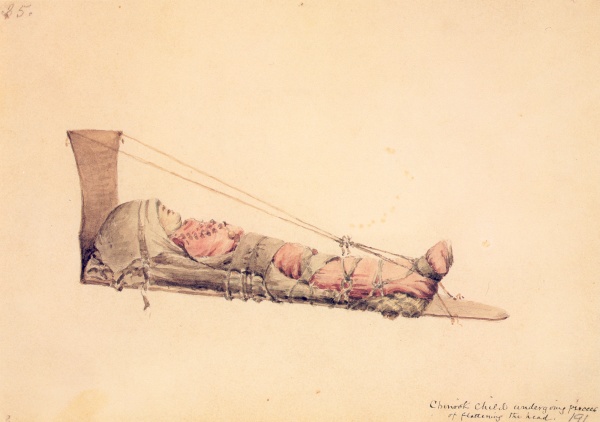

To us those customs look strange. But they show a plain fact: steady, gentle pressure on a growing body reshapes it for life. A narrow, pointed shoe worn every day from childhood is the same kind of device, applied to the foot. We simply stopped noticing it.
Build up wearing time gradually. HMR's view is that years in narrow shoes shape the web of the foot, and that months of spacing can reshape it.
Breath, voice, attention, and food
Bandhas, humming, and chanting
The yogic locks (bandhas) engage the deep web from within; humming and chanting Aum vibrate the body from the inside.
Research: “NO increased 15-fold during humming compared with quiet exhalation” (Weitzberg and Lundberg, 2002, nasal nitric oxide); chanting OM was linked to "limbic deactivation" on fMRI (Kalyani et al., Int J Yoga, 2011); mula bandha gave modest gains in a pelvic floor trial (Sweta et al., 2018). Effects on fascia are HMR's view.
Sing along, mirroring the singer
Sing with a recording and copy the original singer as closely as you can: their phrasing, their breaths, their resonance. Matching another voice changes your posture and the way you breathe while you do it.
Eyes closed, mind on the body
Do the outside-in work with the eyes closed, attending to exactly the place being worked. The aim is a mental connection to the tissue as it changes.
Research: the brain keeps a running map of the body's inner state, called interoception (Craig, 2002). That attention changes fascia is HMR's view.
Eat and drink for fascia
Water through the day, and a diet that leans anti-inflammatory: plenty of fruits and vegetables, Ayurvedic spices such as turmeric and ginger, and what collagen is built from, such as protein, gelatin, and vitamin C. A light emphasis, not a strict diet.
Research: 15 g of gelatin with vitamin C before exercise doubled a blood marker of collagen synthesis (Shaw et al., Am J Clin Nutr, 2017, 8 men). The full fascia diet is HMR's view, still being defined.
Volume, down and up
The protocol works on the tensegrity from the inside, from the outside, and through time. Working through time means deliberately decreasing and increasing the body's volume for short periods, with its own steps for each.
Fasting decreases volume. Eating more on purpose increases it.
To our knowledge, no health or fitness program other than bodybuilding prescribes eating more on purpose to increase volume. HMR holds that it belongs in a holistic protocol. This is HMR's hypothesis.
Every way to change your tensegrity
Anything that moves the web changes it a little, and anything the mind does to the body counts. We sort every method into four kinds.
Hands and tools
Manual force from the surface: your own hands, scrapers, massage, rollers, and massage guns, which reach deep, especially two at once. Tools →
Mind, breath, and stillness
Meditation, breath, sound, and holding a position for a long time, with attention on the place that is changing. Inside out →
Volume, down and up
Fasting to shrink the body for a while, and eating more on purpose to grow it. Volume →
Attention through the day
Brushing teeth, walking between rooms, waking in the night: any moment can be spent working the web. In our experience, a stop on the way across a room can become two hours of tissue work.
Using the toilet, with attention
Passing waste is one of the few moments when the body loses mass from inside the tensegrity. Usually it happens without a thought. HMR's hypothesis is that it can be used. Notice the position of the whole body and which parts are doing the work: the core, the chest, the legs. When the waste has left, hold that position for a few seconds. The web then settles into its new shape without the waste in it, and because what left was waste, each small recalibration should be a slightly better one. Repeated every day, small gains add up.
We know of no one else who does this, and it has not been tested. Use attention, not force: hard straining raises pressure in the chest and abdomen and can make some people faint. We are asking physicists to model what happens when a tensegrity loses an internal mass.
What we did, and what studies have tested
Short visits, given by a therapist
A 2023 review of myofascial release for chronic low back pain found only 6 eligible randomized trials, with 397 patients in all. The treatment was given by a therapist, as a short series of sessions or as a single session of 5 or 40 minutes. The authors say the conclusions "should be interpreted with caution" (Ożóg et al., J Clin Med, 2023). An earlier review found the trials "mixed in both quality and results" (Ajimsha et al., J Bodyw Mov Ther, 2015).
Daily, self-directed, for hours
One person, working on their own tissue every day for hours at a time, for about five years. The work uses many tools: massage guns, scrapers, rollers, vibration, heat, a reformer, and long stretching holds.
Medicine is limited to what a clinician can do to a patient in a short visit. So the dose HMR calls for has never been studied.
This protocol has been tested on one body. We have designed how to test it on a thousand: one year, on one campus, with measured results.
A message from the person behind this work
The rest of this site says "we". Here we want to be plain that one person is speaking, to you.
The idea of HMR came in January 2021. Not long after, while walking, we noticed that our stride was not quite balanced from left to right. It was good enough to get going, and no amount of focus made it perfect. Since then we have kept noticing imbalances that we do not believe are meant to be there, and a lasting sense that the body is meant to be a different shape.
If HMR is true, the first proof would be our own body. So for about five years we have worked on it every day, for hours a day. Outside of a day job, this is the whole of our life: it is what we wake up to, and what we think about and care about. The tissue has gone through stages of change. The first were slight. Later came large structural releases, where a joint seems to turn free of the tissue around it, and ranges of motion we did not think were possible.
It is on video. We have about four years of recordings of this work, several hundred hours, with tools demonstrated and the process explained as it happens. For the past two months there is one from every single morning: the same spot, the same camera on a tripod, the same lighting, and the same short set of movements, turning a full 360 degrees. The recordings also capture the sounds the tissue makes as it releases, loud rips and pops that do not sound like ordinary joint noises. If HMR is right, this is a record of the whole process, from the first person to go through it.
The work was intense, often painful, and beyond what a clinician could do to a patient. Clinicians have a duty of care that limits them, and we respect that. We did this work with attention to safety. This account is not instructions. Tutorials on what to do and what not to do are being prepared, so that others can do it safely.
The body is not yet perfect. We expect to reach the perfect tensegrity before the end of 2027. The next logical step would be extreme athletic performance. If age prevents us, a younger reader will do it.
- January 2021: the idea of HMR.
- November 2026: this site was first shown to its makers.
- December 2026: to be shared publicly.
- Before the end of 2027: our expectation for the perfect tensegrity.
The HMR Fascia Health Protocol is daily care for the fascia web, from the outside in and the inside out, refined through five years of daily practice. It works with warmth, moisture, pressure, vibration, long holds, breath, and attention. Most of it needs no clinic. Each step comes with the reasoning behind it and the published research that bears on it, and what is HMR's own view is marked as such.