Most exercise programs assume the body that is training is already sound. In the Holistic Model of Reality (HMR), few, if any, adult bodies are: each is an imperfect tensegrity, and an imperfect tensegrity carries force unevenly. Training it harder makes the imperfections stronger.
The problem every program shares
An immature tensegrity transmits force the wrong way
The human body behaves as a tensegrity: rigid bones held in place by a continuous, pre-tensioned web of fascia (the evidence is on The Perfect Body). In a well-tuned tensegrity, a load applied anywhere is shared across the whole web. Every cable takes a little, none takes too much, and the structure springs back.
An immature, non-optimized tensegrity is different. Where fascia has become denser, shorter or stuck, those lines carry far more than their share, and the lines around them go slack. Force no longer spreads; it funnels. From a physics standpoint, that is the common problem behind every protocol on this page: the energy of each step, lift or sprint flows through a broken, uneven web, and the same regions are overloaded again and again.
HMR's view of the skin. The skin is an outer layer that pulls inward evenly on what it holds, like the rubber of a balloon. It behaves a little differently from the web beneath it, and experiments on skin can show that. Because it is joined to that web, it is still part of the whole: a more complex biological tensegrity.
HMR's view of a step. The energy of each step travels up from the ground as a wave. The tissue absorbs it, twisting and whipping along its lines to the core, which spreads it through the whole body. In a perfect tensegrity less is lost on the way. During growth the tissue untwists as it lengthens, most of all near the joints. Where that does not happen, a surprising amount of length stays locked up.
By logic from the model: this uneven flow is why so much exercise produces injury, why gains fade when training stops, and why the body redistributes mass in ways people do not want. The cure is not to stop moving. It is to change the order.
A column is not a tensegrity
A column holds weight by stacking: each block presses straight down on the one below. Load it up and, as long as every block is strong enough, it holds. For a column, simply loading it up more or less makes sense.
A tensegrity is more like a great system of pulleys. Every strut and cable passes force on to others, the way a rope passes force around a run of pulleys, and the whole system only works when every pulley is in its proper place. Move one pulley a little and every line pulls slightly wrong; the structure still lifts, but it squeezes inward to make up for it. Move several, and it starts to collapse in on itself. That is why loading an imperfect tensegrity is a different thing from loading a column: the load goes wherever the misaligned pulleys send it.
Peak cable tension
100%
Slack cables
0
Top displaced (% of height)
0.0%
low tensionhigh tensionslackstrut (bone)
Tap a cable to cut it, or choose Break a strut and tap a strut: it cracks in the middle and folds. The weight hangs on a string above the column; cut the string, or press Load it, and it drops onto the top. A simple spring model of a four-module tensegrity column, solved live in your browser. Peak tension is shown as a percentage of the optimized column under the same load. For a full body, see the 3D simulation.
“There are no shears, bending moments or levers, just simple tension and compression, in a self organizing, hierarchical, load distributing, low energy consuming structure.”Stephen Levin on biotensegrity, biotensegrity.com (researcher's own site)
See it work
The body as a system of pulleys
Here is a body standing with its arms out. One rope comes in at the left hand, runs over the left shoulder and over the top of the head, down through the neck and the spine, and up over the right shoulder. There it runs three times between two blocks of wheels, a block and tackle, and holds a weight. Seven pulleys on the body and three in the tackle, one line of pull, the way a long line of fascia runs through the whole body. Even this many pulleys is far simpler than a human body, which is almost beyond comparison in complexity. That is why this site puts humanity's most powerful tools to work on mapping exactly how it works.
Hold the button to pull, then let go. In the optimized body every pulley is where it belongs. The body stays upright and firm, the weight rises one third as far as you pull, for close to one third of its weight in effort, and it falls back when you let go.
Now add imperfections, one at a time. A pulley that is out of place binds the rope, and the web around it no longer holds it properly. No fault stays local: the pulleys next to it on the rope lose some of their seating too. Press the button and the body goes janky first. It sags and wobbles while it takes up slack, then it tightens and the weight starts to move, later and less than it should. The more janky pulleys, the longer the wait and the bigger the wobble. A janky neck or spine hurts most, because the rope runs through the middle of the body. Make every pulley janky and it still lifts, but terribly.
That is the case for the order HMR proposes. Lifting through an optimized tensegrity lifts the weight. Lifting through an imperfect one loads the body instead.
Why pulleys? It is more than a figure of speech. Anatomists call the bands that hold the finger tendons against the bone pulleys (Doyle, 1988). The kneecap redirects the pull of the thigh muscles, and tendons turn round the ankle bones under straps of fascia. Fascia itself comes as broad sheets and as cords, and as the body moves its layers slide over one another on a film of fluid (Stecco et al., 2011), passing force from muscle to muscle (Huijing, 2009). In people with long-term low back pain that sliding is reduced (Langevin et al., 2011). So a line of pull in the body does not run round a neat wheel. It runs over and around a great many surfaces, and each has to be in place and free to slide.
ropebonejanky pulleyglow: strain
Hold the button to pull. Let go and the weight goes back.
Which pulleys go bad? Tap a pulley on the figure, or choose here.
Rope pulled
0 cm
Weight raised
0 cm
Pull needed
0.2 × the weight
Pull lost
0%
Most strained
-
A simple model solved live in your browser. The rope has a fixed length and runs over each wheel along real tangent lines. The weight rises where the geometry lets it rise. At each wheel the pull grows with friction and with how far the rope turns (the capstan effect), and a janky pulley adds a great deal of friction. The tackle balances three strands against the weight. The force the rope puts on each joint tilts it and shifts the pulley, which changes the rope path, and the rope and web stretch a little under load. Janky pulleys make the body sag and sway while it takes up slack, and the time this takes grows with how janky they are. The dashed outline is the optimized body.
What the injury research shows
Shares of people, not counts. These are the people who trained the way most programs teach, and got hurt.
91.3%of adolescent competitive swimmers report shoulder pain. Nearly every one. Feijen et al., 2020
73.5%of CrossFit participants surveyed had been injured while training, most often in the shoulder and the spine. Hak et al., 2013
19.4% to 79.3%of long-distance runners suffer a lower-limb injury. The knee is the most common site. van Gent et al., 2007
What each gets right, and what follows from the model
Red: by the logic of the model, harmful for an imperfect tensegrity. Amber: real value, with clear risks. Green: HMR aligned. Quotes come from the published abstracts.
What all exercise gets right, in HMR
One of the main benefits of exercise is not calories. Movement pumps the body's fluids, makes tissue move, and frees what has stagnated. It refreshes circulation, lymph, and the body's sense of itself, and it builds the mind's map of the body. Every card below gets this right.
Harmful before optimization
Weightlifting and hypertrophy training
What people believe
Lifting stresses and breaks muscle down, and it rebuilds bigger and stronger. That is the usual account, and HMR does not dispute it.
What it gets right
It clearly builds muscle. Strength matters, and resistance training is one of the few exercise interventions shown to reduce sports injuries in trials.
What follows from the model
In HMR the load is stress on the tensegrity, and the tensegrity adapts. In a perfect tensegrity the whole body would take the load and grow evenly, and the gains would be better and last longer. Today the web is not optimized: heavy load travels through fascia that is not ready, and the force reaches a region that cannot hold it. That is where people get hurt. Muscle is built on top of the imperfections and locks them in, and when lifting stops, the tensegrity redistributes that mass in ways people do not want. It does not work the same for everyone, because every tensegrity is in a different state. An open hypothesis in HMR is that an optimized tensegrity, under less stress, may find room to grow again.
“From 1990 to 2007, 25 335 weight training injuries were seen in US emergency departments, correlating to an estimated 970 801 injuries nationwide.” “The most common diagnosis was sprain/strain (46.1%).”Kerr, Collins and Comstock, Am J Sports Med, 2010 (research)
“There was a significant decrease in muscle size following 31-52 weeks of training cessation”Grgic, Int J Environ Res Public Health, 2022, meta-analysis in older adults (research)
Harmful before optimization
Running and jogging
What it gets right
Cardiovascular fitness, time outdoors, and a simple habit almost anyone can start.
What follows from the model
Every stride sends an impact up the body. With an uneven web, that impact is not spread: it is funneled into the same knees, shins, heels, and hips, thousands of times an hour. Joints take what the fascia should have shared. Many people dislike running for a reason; the body is reporting the strain.
“The incidence of lower extremity running injuries ranged from 19.4% to 79.3%. The predominant site of these injuries was the knee.”van Gent et al., Br J Sports Med, 2007, systematic review (research)
“The meta-analyses revealed a weighted injury incidence of 17.8 (95% confidence interval [CI] 16.7-19.1) in novice runners and 7.7 (95% CI 6.9-8.7) in recreational runners.” (per 1,000 hours)Videbæk et al., Sports Med, 2015 (research)
Harmful before optimization
High-intensity interval training (HIIT)
What it gets right
Short, efficient sessions with real gains in fitness.
What follows from the model
HIIT combines high speed, high load, and fatigue, the exact conditions in which an imperfect web fails. Fast, explosive force gives the tissue no time to share load; it hits the weakest line first.
“From 2012-2016 versus 2007-2011, there was a 144% increase in all injuries” “These increases in injury incidence correlated with a 274% increase in HIIT interest.”Rynecki et al., J Sports Med Phys Fitness, 2019 (research)
Harmful before optimization
Most stretching routines
What it gets right
The instinct that tissue needs length and range.
What follows from the model
Short, forceful stretches pull hardest on whatever is already loose and barely reach what is stuck. Holds of 20 to 30 seconds also end before fascia has time to change. Stretching, as usually taught, does not prevent injury in the trials.
“Practical durations of passive stretching resulted in significant decreases in MTS; however, these changes return to baseline levels within 10 to 20 minutes.”Ryan et al., J Orthop Sports Phys Ther, 2008 (research; MTS is musculotendinous stiffness)
Value with risks
Weight-loss programs
What it gets right
Excess weight does strain the body. Losing it also changes the physics and the shape of the system. Like a balloon, a body that has been deflated can be drawn out longer than a full one, which can open the way for other work.
What follows from the model
Diets and calorie-burning exercise treat fat as the cause. In HMR, the body stores it for a reason: where fat sits is shaped by where the web is tight and where it is slack (see the densification section). Without changing the tensegrity, the loss does not last, and the body tends to rebuild the same shape.
HMR's hypothesis
Decrease and increase the volume of the body, deliberately and for short periods, each with its own protocol. Bodybuilders already do this, bulking and cutting. HMR holds that it belongs in a holistic protocol, not theirs alone.
“After 6 years, 41.0 ± 31.3 kg of the lost weight was regained”Fothergill et al. (NIH), Obesity, 2016, follow-up of contestants who had lost 58.3 kg on average (research)
“Current perception is that participants of a structured weight-loss program regain all of their weight loss within 5 y.” In that meta-analysis, people kept off on average 17% to 29% of the weight they lost.Anderson et al., Am J Clin Nutr, 2001 (research)
Value with risks
CrossFit and high-intensity functional training
What it gets right
Whole-body movement that works the fascia web directly, and strong bursts of circulation. Community and variety too.
What follows from the model
CrossFit athletes can be very strong when their tensegrity happens to be tuned well. In HMR, they train without a perfect one, and they would do far better with it. Heavy Olympic lifts, gymnastics, and speed in one session, done tired, put the hardest loads through a web that has never been tuned. That is where the injuries come from.
“A total of 132 responses were collected with 97 (73.5%) having sustained an injury during CrossFit training.” “An injury rate of 3.1 per 1000 hours trained was calculated.”Hak, Hodzovic and Hickey, J Strength Cond Res, 2013 (research)
“Current evidence suggests that the injury risk from CrossFit training is comparable to Olympic weightlifting, distance running, track and field, rugby, football, ice hockey, soccer, or gymnastics.”Klimek et al., J Sport Rehabil, 2018 (research)
Value with risks
Swimming
What it gets right
Water supports the body and removes impact; it is one of the gentlest ways to move.
What follows from the model
Competitive training repeats one stroke tens of thousands of times, through shoulders that may not be ready for it, often in adolescents whose web is still forming.
“Adolescent swimmers showed the highest rates of shoulder pain (91.3%) compared with other age groups (range = 19.4%-70.3%).”Feijen et al., J Athl Train, 2020, systematic review (research)
Value with risks
Cycling
What it gets right
Low impact, good for the heart, easy on most joints.
What follows from the model
Hours in one folded posture, repeating one short arc of motion, shortens the front of the body and loads the lower back and knees the same way every time.
“Fifty-eight percent of all cyclists had experienced lower back pain in the previous 12 months” “Thirty-six percent had experienced anterior knee pain”Clarsen, Krosshaug and Bahr, Am J Sports Med, 2010, 109 professional road cyclists (research)
High value, with risks
Team sports
What it gets right
Play, teamwork, joy, and skill. Play matters a great deal in HMR: it is one of the main ways people learn, bond and enjoy physical reality.
What follows from the model
Sudden cuts, tackles and sprints put peak force through the body with no warning, and an imperfect web cannot share it in time. The value is high and so is the risk, until the tensegrity is optimized.
“Match injury incidence (36 injuries/1000 hours of exposure) was almost 10 times higher than training injury incidence rate (3.7 injuries/1000 hours of exposure).”López-Valenciano et al., Br J Sports Med, 2020, professional football (research)
HMR aligned
Pilates
What it gets right
A lot. Slow, controlled movement, long holds, stretching under control, and whole-body attention. It is pretty good exercise too.
What follows from the model
Pilates comes closest to working with the web instead of against it. Its limit is that it still treats the body as it is, rather than first defining what the optimized tensegrity should be.
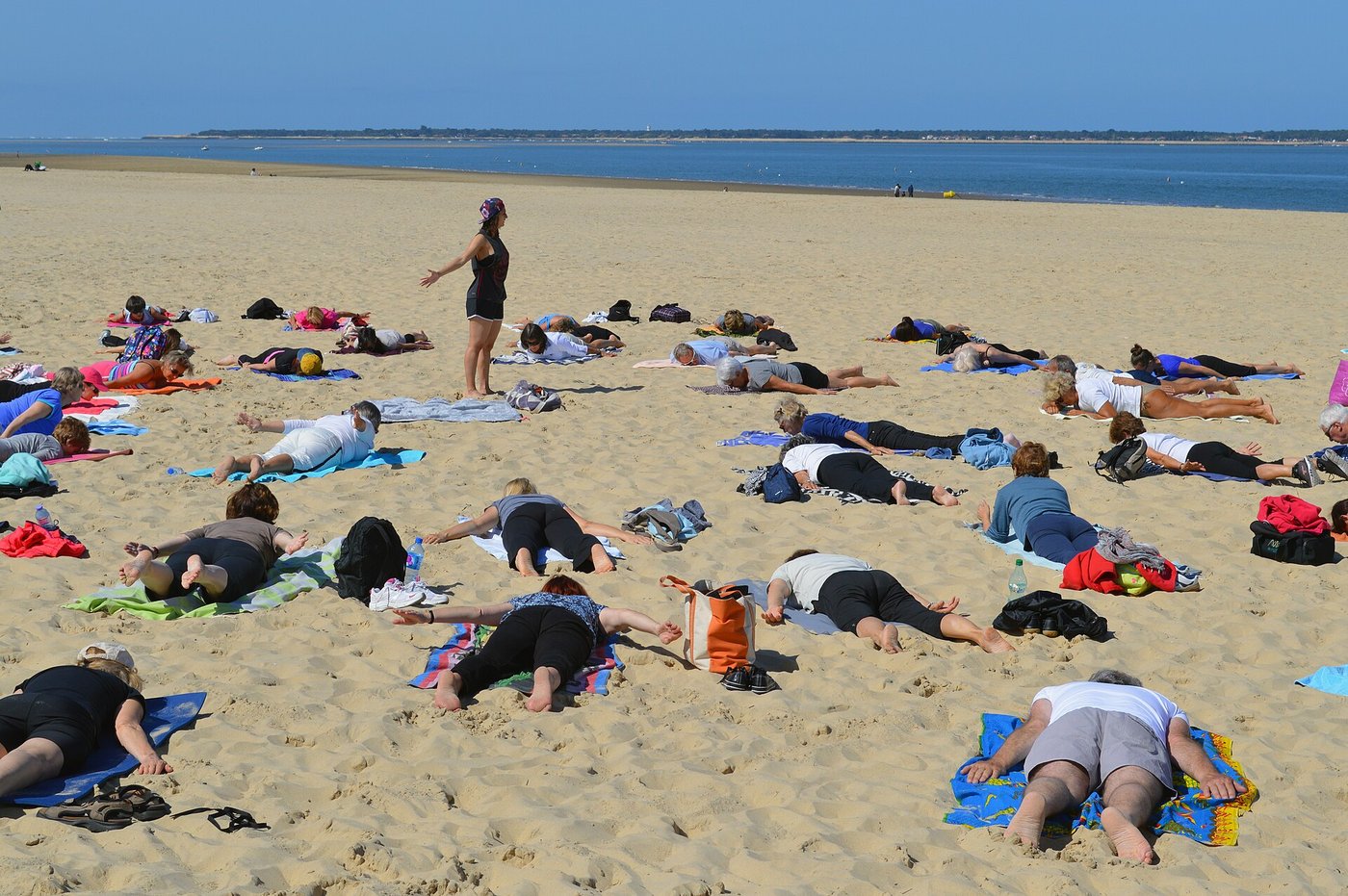
Long-held poses, breath, and attention: the traditions refined exactly the slow, sustained loading fascia responds to. Long hip-opening and yin-style sessions are HMR aligned, close to the protocol.
The risk
Forcing range. Pushing into a pose the web is not ready for strains the same slack regions that every other program strains.
“There were 29,590 yoga-related injuries seen in hospital emergency departments from 2001 to 2014. The trunk (46.6%) was the most frequent region injured, and sprain/strain (45.0%) accounted for the majority of diagnoses.”Swain and McGwin, Orthop J Sports Med, 2016 (research)
A long-hold yoga class, Arcachon, France. Photo: DimiTalen, CC0, Wikimedia Commons.
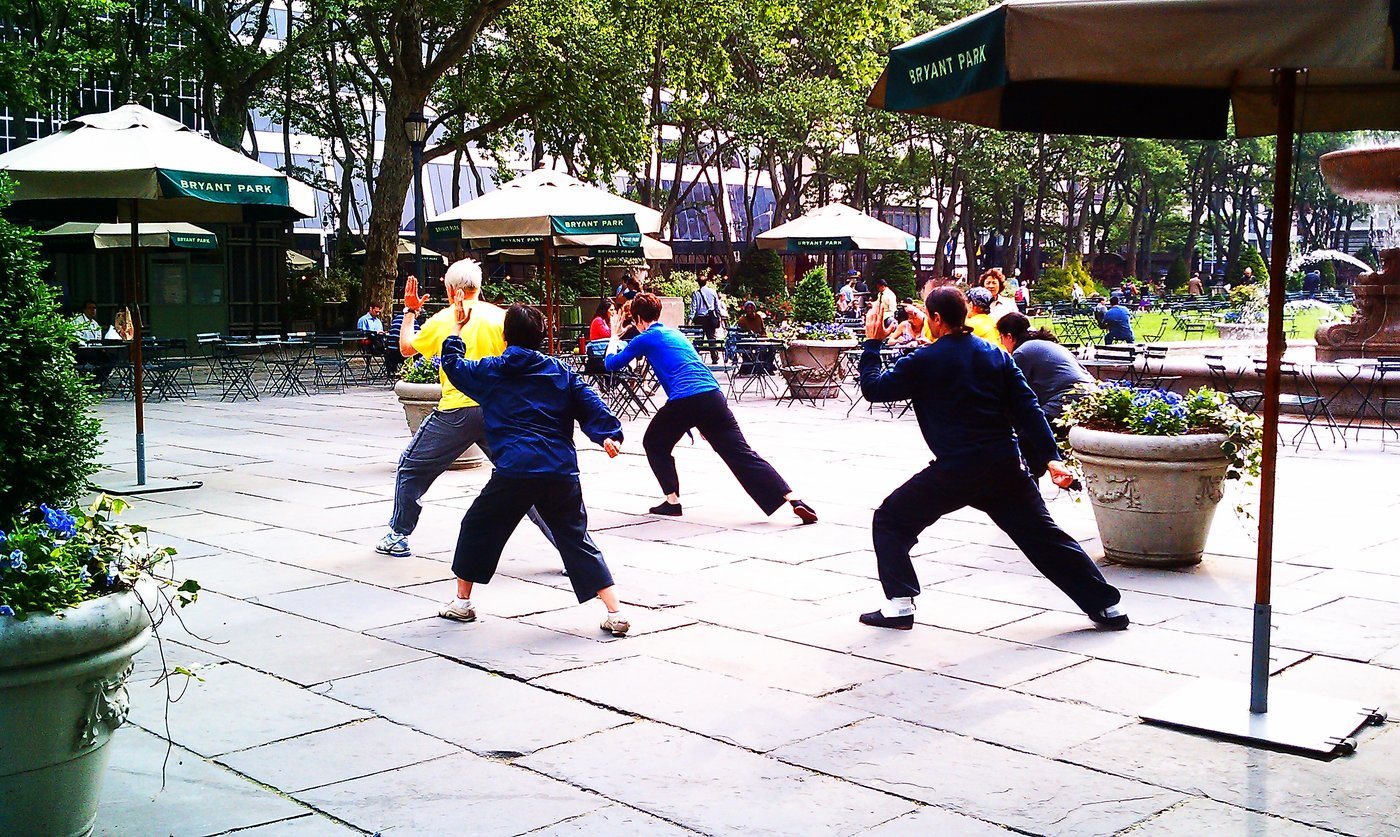
Slow, continuous, whole-body movement with breath, at low load. Among the gentlest forms of exercise studied.
What follows from the model
Excellent for balance and attention. On its own it rarely applies the long, deep holds that change dense fascia.
“TC is unlikely to result in serious AEs, but it may be associated with minor musculoskeletal aches and pains.”Wayne et al., Arch Phys Med Rehabil, 2014, review of 153 trials (research; TC is tai chi, AEs adverse events)
What strength training does to an imperfect tensegrity
The evidence is clear that it helps. Weight-training sports have lower injury rates than many team sports: “the weight-training sports appear to have relatively low rates of injury compared with common team sports” (Keogh and Winwood, Sports Med, 2017). In trials, “Strength training reduced sports injuries to less than 1/3 and overuse injuries could be almost halved” (Lauersen et al., Br J Sports Med, 2014).
In HMR, the web adapts. From infancy to adulthood the bones push outward through growth, and the fascia web adapts to that push. It lays down adhesions and clears them again, and fibroblasts and other cells remodel it all the time. It behaves like a living thing in its own right, and training loads that living web.
It follows by logic from the model that this fits. There are many ways to make an imperfect tensegrity more capable, and strength training is one of them. It strengthens the web in the shape it already has, including its adhesions, and it accustoms the fascia to the very movements the sport demands, so injuries fall. The body gets stronger in its imperfect shape.
It follows by logic from the model that the cost is long term: imperfections that have been strengthened are harder to undo, and may show up later as chronic problems. HMR's claim is about order. Optimizing the tensegrity first, as the protocol does, is the slower way and by the logic of the model the safest and most lasting one. The same training on an optimized tensegrity then does far more good and far less harm.
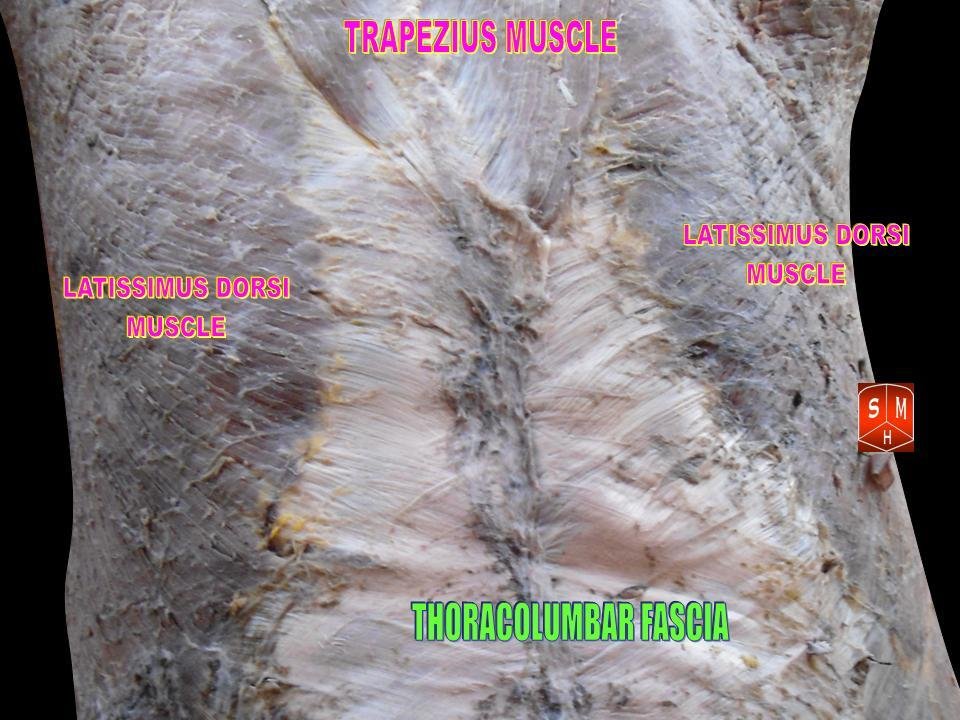
The thoracolumbar fascia links the shoulders, spine, pelvis, and legs in one sheet, so strength built in one place is carried across all of them. Photo: Anatomist90, CC BY-SA 3.0, via Wikimedia Commons. See it on The Perfect Body.
Physical therapy
Where the tensegrity work belongs
Physical therapists are the people best placed to work on the tensegrity. They already work hands-on with movement, load, and recovery. Today they are not trained on a tensegrity model of the body. HMR sees that as one of the largest gaps in physical health care, and therapists are the ones who can close it.
HMR's order
Tensegrity first. Strength second
Define the optimized tensegrity. A physics model of the ideal human body, built from measurements, shows what each line of fascia should be. The Perfect Body →
Mature the web toward it. Hydration, long holds, hands-on work, and the inside-out practices that make fascia receptive to change (the HMR Fascia Health Protocol).
Then train. Once force is shared evenly, strength, speed, and endurance build on a sound structure instead of on its faults.
Done the other way around, exercise mostly reinforces the imperfections: the dense lines get denser and the slack ones weaker, and each year of training makes the faults harder to undo.
What follows by logic from the model
Training an optimized tensegrity
No pain. Load spreads through the whole web, so no single joint or tendon takes the hit.
Much stronger. Every line contributes, so the whole body lifts, not a few overloaded muscles.
Lighter. A well-tensioned structure holds itself up; less effort goes into bracing against its own faults.
More capable. Range, balance, and speed come from the structure itself, and gains stay when training pauses.
The solution: teach it, share it, start with children
Fixing exercise is an education problem before it is a training problem. HMR's plan: teach everyone what an optimized tensegrity is, develop open protocols that can be shared worldwide, and make fascia care as ordinary as brushing teeth.
The highest priority is children, before puberty and during it, when the web is still being built and is easiest to shape.
What the model says about puberty
Science describes puberty as a cascade of hormones, and the hormones are real. What sets it off is not settled (Livadas and Chrousos, 2019). In HMR, the hormones come on because of how a growing tensegrity behaves when it comes under strain.
In HMR, puberty is a signal that the growing tensegrity is reaching its bounds, and that the inner struts need to be aligned properly. If they are not, some parts grow faster than others, tension becomes uneven, and the tensegrity develops imperfections. So far in human history, adults have carried those imperfections for life. Now there is a protocol to work them out again. The protocol →
Even so, the most valuable fascia care anyone ever receives is the care given to them as a child. Do you have kids? →
In short
Most exercise assumes the body doing it is already sound. In HMR the body is a tensegrity: bones held apart by a continuous web of fascia, working like a great system of pulleys. Exercise loads whatever shape that web is in, so training an uneven body strengthens the unevenness. HMR's order follows by logic from the model: even out the fascia web first, then train. The page rates common kinds of exercise by how well they fit that order.