What Universe Model is
Universe Model presents the Holistic Model of Reality (HMR): one connected account of reality, from before the Big Bang to the human body, and a research program to put its most concrete claim to the test by building the human body as a working, physics-based simulation.
What you are reading
The Holistic Model of Reality is one continuous line of logic, from before the Big Bang to the human body and the way a person lives a single day. Nothing on this site is a story to browse. It is meant to change the world.
The starting point is simple. In HMR's view, materialism, the belief that only matter is real, has not explained why anything exists, what consciousness is, or what a life is for. So HMR takes the other road and walks it carefully: assume there is a God, a Universal Intelligence, and reason step by step, pragmatically, about what follows. Whatever words people use, most would agree that if the universe comes from God, it is in some way God's thought. HMR agrees, and sets out how those thoughts work.
Where HMR has open questions, science has open questions too. HMR's largest gap is mathematical: it does not yet derive the physics we measure from its starting point. Our math and physics pages show how far that work has come, and we are asking for help to finish it.
Most people have decided that no one they know will change the world. We do not accept that, least of all now, when one person with AI can do the work of a whole team.
The person who wrote this site has held these ideas for five years, and living every day as if they are true is still hard in a world that does not share them. Expect that if you take HMR on. Humanity is in a transition, and the transition is part of the work.
The core of HMR in three sentences
A Universal Intelligence exists. Before the Big Bang it was unlimited. The Big Bang is the manifestation of a system in which that Universal Intelligence imposes limits on itself.
This is HMR's premise, not an established result. We state it plainly, reason forward from it step by step, and tie each claim that follows to something that can be tested.
The God question
Explain and define the mechanics by which an unlimited Universal Intelligence created a reality in which it is limited.
When people ask HMR about God, what God is, or how to think about God, this is the specific question HMR answers. If one accepts the premise above, the problem of God becomes the problem of how a reality went from unlimited to limited: what the self-imposed limits were, and why.
Open: HMR has not solved it. Our current attempts are on the Universal Intelligence and math pages, and we say where they fall short.
What a holistic model of reality is made of
A model is only usable if it can be reduced to its smallest parts. In HMR's view, there are three: a mind, a body, and the marriage between them.
A Universal Intelligence exists
The first part is that Universal Intelligence exists, what it is, and what our relationship with it is. A person who leaves this part out has a different model of reality, whether or not they know it.
HMR's view. The premise above. Defining UI →
Fascia, the body's main structure
Fascia is the continuous web that holds the body together. HMR holds that it is a tensegrity, and that humanity has understudied it. Most people act as if fascia is unimportant, so attending to it is a vast open landscape.
HMR's view, with parts shared by other researchers (see East and West). The body model →
The physics between them
The third part is the physics and the relationship between Universal Intelligence and your body: how one intelligence acts through a body that is one connected structure.
HMR's view, and its least finished part. It is still open mathematically. The math → The physics →
Two models, side by side
What each includes, what each lacks, and what follows from each. These are HMR's views of both.
The materialist model
Includes- Matter and energy, and the laws that describe them.
- Measurement, experiment, and the scientific method.
- An account of why anything exists, what consciousness is, and what a life is for.
- A defined, fully healthy body to measure against.
- A foundation for values.
- Technology and medicine. These are large, real, and established.
HMR
Includes- A Universal Intelligence, and our relationship to it.
- The body as a fascia-first tensegrity.
- The physics linking the two. HMR also keeps science's method and its results.
- Finished mathematics that derives the physics we measure from its starting point.
- Completed tests. The first, the simulation, is still being built.
- A compass. A way to decide what to do moment to moment, a north star, plus what materialism gives.
An account of what is, what should be, and what could be
HMR also tries to say why humanity has not had this model before, and why it has it now. In HMR's view, the pieces were never in one place: fascia has been understudied, and most research on it dates from about 2000 onward. The tools to connect so many fields are also new. Why now →
This is HMR's view of its own history, not a proven fact. We hold it open to testing like everything else.
The problems humanity faces share a root
Chronic disease is rising and is rarely reversed. Mental illness is widespread and poorly understood. People are divided over what is true, what is right, and what life is for, between neighbors as much as between nations.
These look like separate problems, handled by separate experts: doctors, psychiatrists, scientists, priests, politicians. HMR's view is that they share a root. After thousands of years of philosophy and centuries of science, humanity still cannot say what reality is. It has no agreed account of what a human being is, or of what a healthy body and a sound mind look like.
Each discipline works deeper and deeper into its own corner, and the corners never meet. It is like a thousand people each assembling one part of a jigsaw puzzle, none of whom has ever seen the picture on the box.
- Health has no defined healthy body to measure against.
- Mental health has no agreed account of what is real to measure minds against.
- Science describes how reality behaves, not what it is.
- Values have nothing firm to rest on, so they divide us.
Everyone has a model of reality. Almost no one has a holistic one
A model of reality is the picture of the world that any living thing acts on: what exists, how it behaves, what matters. Having one is not optional. A bacterium, an animal, and a human being each operate on one. Each model has higher or lower fidelity than another, depending on the sensory hardware that gathers it and, possibly, the mental faculties that interpret it. A bat's world is built from echoes, a bee's from ultraviolet light, a human's from five senses and the instruments built to extend them.
So a model of reality starts in the body. The body is the hardware, and it sets the limits of what a being can experience at all: with eyes you see, without them you do not. The mind then interprets those signals and builds a sense of identity from them: there is a me, there is something that is not me, and the two interact. From that picture a being works out what to do. What feels good and does no harm, it keeps doing; what turns out to harm, it learns to stop; and it weighs the one against the other. That weighing is the start of a value system.
This is why partial models fall short in a way that matters. A value system needs the whole context: what I am, what everything else is, and how we are connected. A partial model does not have that context, so it cannot say what is truly worth doing. Only a holistic model can.
Humanity's best models to date are partial. Physics models matter, biology models life, medicine models disease, psychology models the mind, religion models meaning. Each can be divided into ever finer detail, and still miss what only appears when the system is seen as a whole. It is like an engineer who knows every part of a bridge except where it is anchored.
A holistic model of reality is different in kind. It joins the parts into one connected theory, so that understanding one part gives insight into every other.
Most people live by partial models of reality. What humanity needs is a holistic one, and if HMR is right, it has never had one before.
That would mean humanity has always run without an operating system: billions of capable minds, each running on fragments. HMR is offered as that operating system.
There is a theorem for this. Any system that steers something well must contain a model of the thing it steers: “every good regulator of a system must be a model of that system” (Conant and Ashby, 1970). A person steering a life with a partial model of reality is a regulator with part of the system missing. It can be exact about the parts it has and still steer wrong.
Engineers have an exact test. A system can be fully steered only if every part of its state can be seen and every part can be reached (Kalman, 1960). When that holds, information runs through the whole system and it can be tuned as one thing. Miss one part and no skill with the rest makes up for it.
One missing fact can reverse a conclusion. In Simpson's paradox a treatment that helps every group of patients looks harmful when the groups are pooled, because one variable was left out. So a value system can be sincere and careful, and still do harm, because of one thing it does not know about what a person is.
Materialism has to hold that the whole universe began as a speck smaller than an atom and blew up. HMR holds that Universal Intelligence imagined it, the way you can imagine a whole dream from nothing. Defining Universal Intelligence →
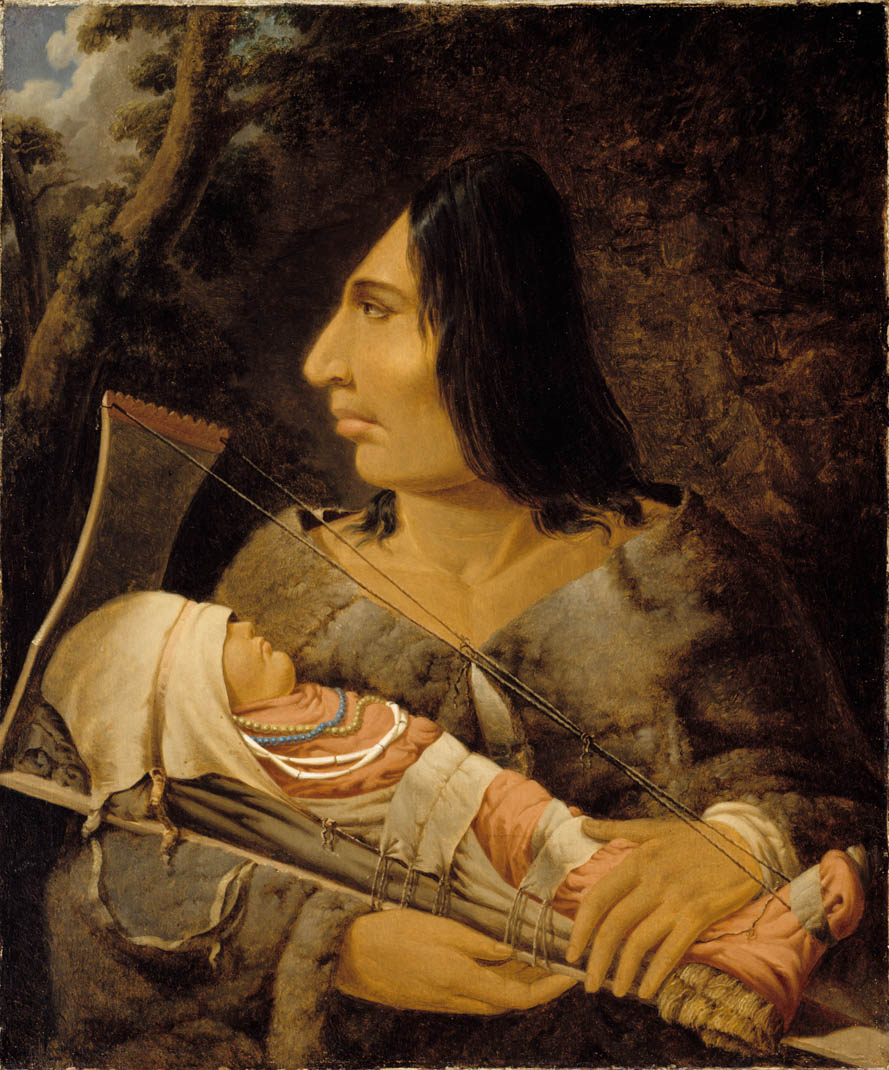

The first example, as an artist who went there painted it. On the Columbia River and the coast north of it, a baby spent its first year strapped to a cradleboard, with a second board bound across the forehead. The soft skull grew into a long, flat slope. Look at the woman's profile: her head was shaped the same way when she was a baby. To her people it was beautiful, and it marked a free person of standing. Slaves and outsiders did not have it. Kane, who traveled there in 1847, called it a “distinguishing mark of freedom”.
The parents who did this were not cruel. They did it out of care for their child, on the best model of reality they had. To them it was right and normal. By today's standards it looks like harm done to a baby.
Binding the head acts directly on how the fascia develops. Today's parents believe they are treating their children properly, as these parents did. HMR says every parent today is leaving out the most important thing they could do for their children: care of the fascia. If HMR comes to be believed, people will look back on parents who did not care for their children's fascia much as we look back on this.
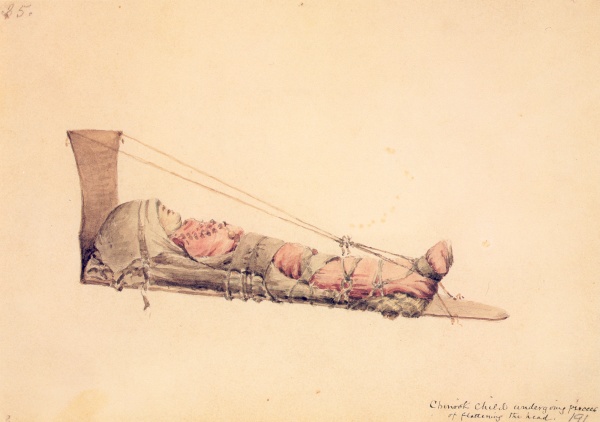

The oil painting is a studio composite: Kane combined his separate field sketches of a woman and of an infant, and shows the board lifted rather than pressing (Art Canada Institute). How the cradle worked, and that the custom lasted into the twentieth century: Pitt Rivers Museum, University of Oxford.
How a person acts depends on how they see reality. Someone who sees it differently from the people around them will act differently, and those people may judge it crazy or plainly wrong.
None of these people is careless. Each is following a model of what is real, and the verdict comes from the model. That is why a value system is only as good as the model under it, and why a partial model can lead sincere people to the wrong conclusions and cause them to act against their own true values.
One account, from before the Big Bang to the human body
HMR proposes that physical reality emerges from Universal Intelligence (UI), a non-physical intelligence that has matured over time toward greater coherence, and that each human is an instance of UI living through a physical body. It draws on modern science and on the world's contemplative traditions, and is not affiliated with any religion.
Its most concrete and testable part is the human body understood as a tensegrity held together by fascia. That is where the work begins: with a new model of health, a model of mental health, and a physics-based simulation of the ideal human body.
Imagine a doctor who has studied every organ in a laboratory, one at a time, but has never met a living person. They could describe the heart, the lungs, and the liver in perfect detail and still not understand that together they make someone who laughs, walks, and thinks. Humanity's knowledge is in that position. HMR is an attempt to supply the missing view: what the whole is, so that the parts make sense.
Science today → Universal Intelligence → The simulation →
If this resonates with you, engage with us here.
“The universe begins to look more like a great thought than like a great machine. Mind no longer appears to be an accidental intruder into the realm of matter.”
James Jeans, physicist and astronomer. The Mysterious Universe (1930). Source
Select a topic for HMR's short answer.
The origin of physical reality and its laws
Before physical reality, HMR describes UI as unlimited intelligence without order. It settled on orderly thought, and its first structured thought separated a "me" from a "not me": a distance between two points. From that came spacetime, then matter. The laws of physics are the rules UI holds fixed so that many separate beings can share one stable world. More →
Why mathematics describes nature
Science has never explained why the universe obeys equations. In HMR the answer is direct: mathematics came first. Geometry, ratio, relationships, and π were among the original orderly thoughts from which physical reality was built, so nature is mathematical because it is made of mathematical thought.
What life, death, and a human being are
Life is UI placing many instances of itself into one shared world, from bacteria to animals to people, so that they learn from one another. A human being is UI's most advanced instance in physical reality. Death is a transformation, not an end: the experience of a life is kept and added to UI's understanding, and the transition may differ for every form of life.
The body as a tensegrity, and disease as deviation from its ideal
Bones act as struts and fascia as a continuous web of tension around them, so the body holds its shape the way a tensegrity does. A perfect tensegrity is the reference for full health. Every physical condition is a measurable deviation from it, and HMR's first test, the densification hypothesis, asks whether denser fascia alone can produce the shapes of real disease.
The mind, sanity, and mental health
Sanity can be measured three ways: how true a person's picture of reality is, whether they can achieve what they set out to do, and how they interact with other people. Today's institutions use the last two, because the first needs an agreed account of reality. HMR also links the mind to the body: posture, tension, and the brain's maps of the body shape how a person feels and thinks. More →
How the world's traditions and modern science describe the same source
UI is what traditions have called God, Brahman, or the Tao. People who studied their own bodies and minds for a lifetime, in yoga, martial arts, and meditation, found practices that work on fascia and found a source behind reality. Science measures the same body from outside. HMR offers one language for both. No one has to give up their tradition: every tradition is a set of thoughts within HMR that began at a different place in human history, so none is excluded. More →
Why the Big Bang happened
The Big Bang was the moment UI's first model of itself, a "me", a "not me", and the distance and boundary between them, became complete and closed. That completed system set off everything after it. The step-by-step account →
What gravity is
In HMR, distance is the first quantity reality ever had, and gravity is reality's trend toward coherence: coherent matter draws together and takes up distance. The full mathematics is open work. Version 2 adds a conjecture: gravity is the large-scale behavior of the order of thoughts, not a force within it. Where physics stands →
Consciousness, and how mind and body connect
Consciousness is UI itself, the awareness behind every life. The mind is how that awareness thinks inside one body, and the body, through its fascia and nerves, is how it engages with the physical world. What a person is, is the whole mind-body system. More →
What God pays attention to, and how prayer works
UI experiences every life from within, here and now, so it attends to everything at once, through each of us. It works through the laws it set rather than breaking them. Defining UI →
Suffering, mistakes and why the world is imperfect
UI matures by stages, as a person does, and maturing means testing limits and sometimes failing. Suffering is real, and part of the purpose of a human life is to help minimize the suffering of all creatures. HMR Values →
What life is for, and how to live
To take part in UI's maturation: push your limits, learn, treat others as you would want to be treated in their place, care for your body, and appreciate the experience. Humans are agents of experience and interpretation. Taking part in UI's maturation is an active process that is not finished: it progresses the universe through what we experience and understand. No other creature can contribute as much, through language, writing, and computers. HMR Values →
Animals and all other life
Every living creature is an instance of the same UI in a different body, so the care owed to people extends to all life. HMR Values →
Artificial intelligence
Humans building AI is a copy, at a smaller scale, of what UI did in making us, and it is happening now, alongside HMR, for a reason. Humans as UI's AI →
Children, and how to raise them
Childhood, especially puberty, is when the body's tensegrity is shaped most. Fascia care from birth, and a clear account of what a child is, change the course of a life. HMR also holds that children raised with its values, among adults who share them, make a better world. Do you have kids? →
The future of humanity
Three steps, from most to least certain. First, the health shift, the most scientific part. Second, the further benefits that follow if the world shares these values. Third, the golden age that Eastern traditions describe, which HMR treats as a logical next step. East and West → Below →
What people will do differently
HMR changes behavior for two reasons: because of the values it rests on, and because it treats the body as a tensegrity.
- Treat every living creature as the same Universal Intelligence in another body.
- Work to relieve suffering in all life, human and animal, near and far.
- Share one value system from person to person, city to city, and country to country. The values →
- Carry a lifelong side quest, from the time a child can talk: build the best tensegrity you can.
- Attend to the tensegrity in ordinary moments: brushing teeth, walking from room to room, even using the toilet. Every way to change it →
- Eat and drink to give the tensegrity what it needs to rebuild.
- Say "my tensegrity" instead of "my body".
Most of the words we use for ourselves were made by people with a different picture of reality. HMR suggests words that match its own.
My body becomes my tensegrity.
My mind becomes my instance of Universal Intelligence.
My experience becomes my experience as Universal Intelligence.
I and me stay the same.
A map of the site
The site is built as one story, from start to finish. Read it page by page with the Next link at the bottom of each page, or use these cards, set out in the order of the top menu, to jump straight to whatever interests you most.
The gaps in modern science, from gravity to consciousness, and why they matter to anyone who values reason.
Exercise todayWhy HMR holds that the tensegrity should be optimized first, and exercise built on top of it.
Mental healthWhat sanity means, a history that keeps repeating, and how the body, belief, and society shape the mind.
Universal IntelligenceWhat UI is, its life cycle from before the Big Bang to now, and its capabilities and limits.
The perfect bodyWhy health should be measured against an ideal human body defined by physics, and the central hypothesis we will test.
Defining Universal IntelligenceWhere HMR differs from science: an account of what came before the Big Bang that never breaks logic.
HMR valuesA value system grounded in what reality is, from how we treat each other to how we treat every creature.
East and WestHow the world's body practices and traditions work on fascia, and HMR's language for joining them with science.
SimulationAn interactive 3D human tensegrity, the evidence behind it, and how the full model is being built.
Road AheadHow the data becomes a simulation of the ideal body, then a campaign of millions of simulated bodies, then a new paradigm for health.
The libraryExactly what has been collected: documents, the scholarly record, the Visible Human, images, films, and measurements.
Get in touchPhysicists, scientists, clinicians, and anyone with data, questions, or criticism: we want to hear from you.
Every person lives by a model of reality, and almost no one has a holistic one. Most of what divides people comes from working with different, partial pictures of what is real. Universe Model presents one account, from before the Big Bang to the human body, and is building the means to test it, starting with the body. If HMR is true and people come to share it, a common purpose, better health, and things that sound impossible today follow from it by logic.
Get in touch
Physicists, scientists in every field, researchers, clinicians, movement teachers, athletes, and anyone with data, questions, or criticism are welcome to write. We especially want to hear where you think the model is wrong.
Would you like to be part of this? Tell us who you are on the Collaborators page, or write with the subject Interested collaborator.